
Alien Abduction and the Examination Table: What Can Science Actually Tell Us?
By Fernanda Pires
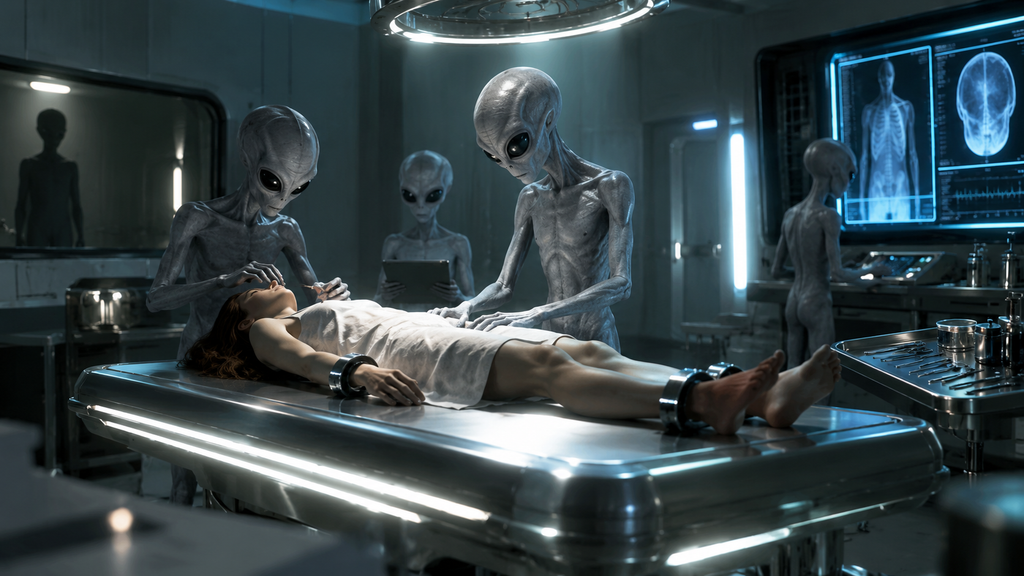
Few images in the history of UFO/UAP experiencer reports are as disturbing or as persistent as the examination table.
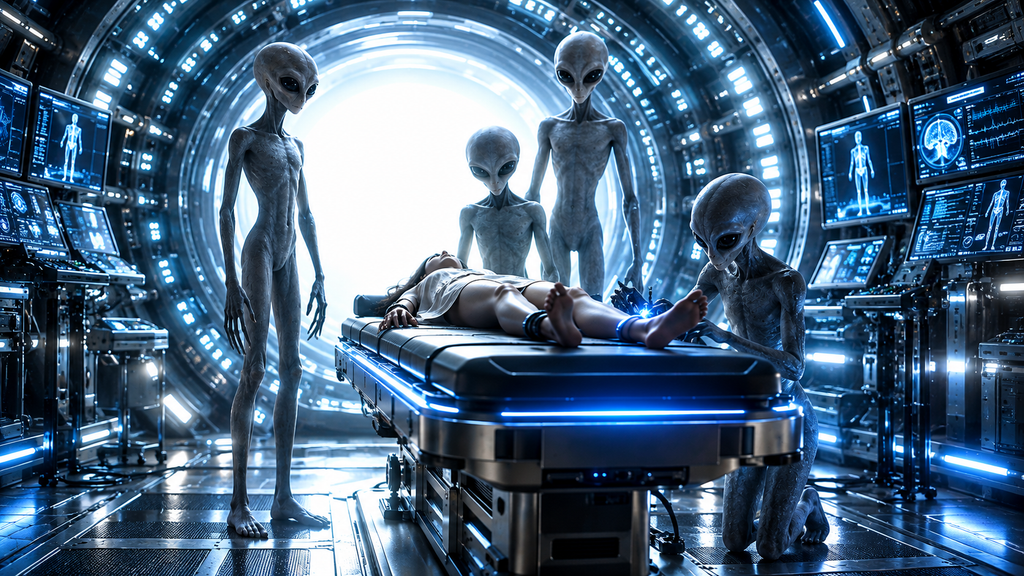
A person awakens, or becomes aware, in an unfamiliar environment. Movement is difficult or impossible. Figures stand nearby. There may be intense light, unfamiliar instruments, bodily manipulation, telepathic impressions, missing time, or the perception that some type of medical procedure is taking place. In some accounts, the individual later discovers an unexplained mark or scar. In others, the experience is remembered spontaneously, while additional details may emerge much later.
Within UFO literature, this sequence has become one of the most recognizable elements of the alleged alien abduction phenomenon.
But recognition is not explanation.
The scientifically important question is not simply whether people report such experiences. They clearly do. The more difficult question is what produces them and whether all experiences grouped under the label “alien abduction” actually arise from the same underlying phenomenon.
That distinction should be fundamental to any serious investigation.
The Recurring Examination Narrative
Accounts commonly classified as alien abduction experiences contain a cluster of reported features: immobility or restraint, a perceived nonhuman presence, examination of the body, unusual lights or instruments, altered perception of time, communication apparently occurring without ordinary speech, and intense emotional responses ranging from terror to unusual calm.
Some narratives include reproductive or sexual procedures. Others describe attention being directed toward the eyes, head, nose, ears, abdomen, or extremities. Reports of needle-like instruments, tissue collection, scanning devices, and objects allegedly introduced beneath the skin also occur throughout abduction literature.
The popular image of the “Gray,” a small humanoid figure with a large head and prominent dark eyes, became especially associated with such narratives. Other reported morphologies include taller humanoids and insectoid or mantis-like entities.
For investigators, however, recurrence must be treated carefully.
Similar descriptions could potentially reflect a common external stimulus. But similarity can also arise from shared human neurobiology, common cultural imagery, expectations, memory processes, exposure to previous accounts, or some combination of these factors.
Pattern recognition is the beginning of an investigation, not its conclusion.
When the Brain Awakens Before the Body
One of the strongest conventional explanations for at least a subset of abduction-like experiences is sleep paralysis.
During rapid eye movement, or REM sleep, the brain normally suppresses most skeletal muscle movement. Occasionally, awareness returns while this REM-related muscle atonia persists. The person can perceive themselves as awake yet remain temporarily unable to move.
That alone can be terrifying.
But sleep paralysis can involve considerably more.
Scientific literature documents vivid visual, auditory, and tactile experiences during these episodes, including the perception of an intruder or presence, human-like figures, sounds, pressure on the body, difficulty breathing, floating sensations, and intense fear.
Researchers have described several recurring components. An “intruder” experience involves the sensation that another being is present, sometimes accompanied by visual or auditory hallucinations and profound fear. An “incubus” experience can involve pressure on the chest, breathing discomfort, and the perception of an entity interacting physically with the person. A third group involves unusual bodily sensations such as floating, flying, or out-of-body experiences.
The parallels with some reported bedroom abduction narratives are striking.
This does not scientifically establish that every person reporting an abduction experienced sleep paralysis. It demonstrates something narrower but extremely important: human neurophysiology is capable of generating several components traditionally associated with abduction experiences without requiring an external physical agent.
Therefore, an investigation involving an experience occurring while falling asleep, awakening, or lying in bed should document sleep history as carefully as it documents astronomical or aviation conditions.
The Examination Table May Have Another Scientific Parallel
There is another intriguing hypothesis.
Psychiatrist David V. Forrest has noted similarities between some alien abduction narratives and human medical or surgical experiences: altered consciousness, bright lights, unfamiliar figures surrounding a helpless patient, pain or bodily manipulation, medical equipment, and loss of physical control. He proposed that previous medical or surgical experiences could potentially contribute to the imagery incorporated into some abduction narratives.
That possibility deserves attention because memory is reconstructive rather than a perfect recording of events.
The brain does not simply retrieve an untouched video file whenever we remember something. Memories can be modified by subsequent information, expectation, suggestion, and repeated reconstruction.
This becomes especially important when an extraordinary experience is investigated through hypnosis or highly suggestive questioning.
Memory Is Evidence, but It Is Not a Recording
A witness’s recollection is an essential component of an investigation, but recollection must be handled carefully.
Laboratory research involving people reporting recovered memories of alien abduction found greater susceptibility in that sample to false recall and false recognition in a particular experimental memory paradigm compared with controls. Importantly, that finding does not demonstrate that their reported experiences were false. It demonstrates that memory itself must be treated as a potentially fallible source of evidence.
This has significant implications for UFO investigation.
Questions such as “What happened next?” are fundamentally different from “Did they put you on a table?” or “Was something implanted in you?”
The latter questions introduce information.
Once introduced, that information can potentially become incorporated into subsequent recollection.
For that reason, investigators should favor neutral, open-ended interviewing and carefully distinguish between details spontaneously reported by the witness and information that appeared only after hypnosis, regression, repeated interviews, exposure to UFO literature, or leading questions.
An extraordinary account becomes scientifically stronger, not weaker, when investigators actively protect it from contamination.
What About the Consistency Across Different Witnesses?
This is perhaps one of the most interesting questions.
If people separated geographically and culturally report similar experiences, should that similarity itself count as evidence?
It counts as data.
But interpreting that data requires caution.
Sleep paralysis research is particularly instructive because similar experiences of paralysis, threatening presences, and unusual entities have appeared in different cultures, while the identity assigned to the perceived presence can vary according to cultural context.
This tells us something important: different people can experience similar underlying physiological phenomena while interpreting them through different cultural frameworks.
The same methodological caution must therefore apply to abduction reports.
At the same time, investigators should not simply label every case “sleep paralysis” because paralysis occurred. A hypothesis should explain the entire evidentiary record, not merely one convenient feature.
If a case includes independently corroborated observations, synchronized witnesses, objectively documented physical effects, instrument data, or other evidence occurring outside a sleep-related context, those elements require separate investigation.
The Problem of Alleged Implants
Claims of objects implanted by nonhuman entities represent one of the most dramatic areas of abduction literature and one where scientific standards must be particularly demanding.
Finding a foreign object in the human body is not, by itself, evidence of extraterrestrial technology.
Foreign material can enter tissue through injuries, occupational exposure, previous medical procedures, and numerous unnoticed everyday events. Establishing an anomalous origin would therefore require much more than discovering that an object exists.
A scientifically useful investigation would require documented medical imaging before removal, a clear chain of custody, sterile extraction, appropriate controls, independent laboratory analysis, elemental and isotopic characterization where warranted, microscopy, and comparison with known terrestrial materials.
The critical question is not:
“Is there something inside the body?”
It is:
“What is it, how did it get there, and what evidence excludes ordinary explanations?”
Until those questions are answered under controlled conditions, the scientifically appropriate classification is unidentified foreign material, not “alien implant.”
Scars Are Evidence of Injury, Not Automatically Evidence of Cause
The same principle applies to unexplained marks.
A scar, puncture, bruise, or lesion may demonstrate that something happened to tissue. It does not necessarily establish what produced it.
An investigator should document dimensions, morphology, location, photographs with scale, medical history, previous injuries, and changes over time. Whenever appropriate, evaluation should be conducted by qualified medical professionals rather than interpreted solely within a UFO framework.
The distinction between observation and interpretation is essential.
“Three circular marks appeared on the left leg” is an observation.
“Aliens produced three circular marks” is a causal conclusion.
Evidence must connect the two.
Trauma Without a Proven External Event
There is another mistake investigators should avoid: assuming that because an event cannot be independently verified, the person’s distress is therefore unreal.
Research involving individuals reporting alien abduction memories has found that recalling these experiences can be associated with substantial psychophysiological responses. Another study found that emotional reactions to alleged abduction memories can resemble reactions associated with traumatic experiences.
That distinction matters.
A researcher can remain agnostic about the external cause of an experience while recognizing that the witness may have experienced genuine terror, helplessness, confusion, or long-term psychological consequences.
Respect for the experiencer does not require accepting every interpretation.
Scientific skepticism does not require ridiculing the witness.
Those principles can and should coexist.
Beyond the False Choice: Aliens or Hallucination
The public discussion of abduction experiences is frequently reduced to two extremes.
Either extraterrestrials physically abducted the witness, or the witness imagined everything.
Scientifically, that is an inadequate framework.
The category we call “alien abduction” may encompass experiences with multiple origins: sleep paralysis, hypnagogic or hypnopompic hallucinations, dreams and false awakenings, memory reconstruction, medical experiences, psychological factors, misidentified environmental stimuli, deliberately fabricated accounts, and potentially cases containing observations that remain unexplained after reasonable conventional hypotheses have been examined.
There is no scientific requirement that every report assigned the same cultural label must have the same cause.
That may ultimately be one of the most important lessons for UAP research.
What Would Constitute Stronger Evidence?
If the examination table phenomenon is to move from testimony toward testable science, future investigations should concentrate on evidence capable of existing independently of memory.
Multiple independent witnesses reporting an event before discussing it with one another would carry greater evidentiary value than a single reconstructed account. Contemporaneous photographs, video, physiological monitoring, environmental measurements, or independently documented physical changes could provide additional information.
So could medical findings documented before the witness develops an interpretation of their cause.
Precise timelines matter.
Sleep records matter.
Medication and anesthesia history may matter.
Aircraft and satellite activity may matter.
Phone records, security cameras, and location data may matter.
And when physical material exists, chain of custody and independent laboratory replication matter enormously.
The objective should not be to prove an abduction.
Nor should it be to disprove one.
The objective should be to determine what the evidence allows us to conclude.
The Examination Table Remains a Question, Not an Answer
The image is undeniably powerful: a conscious human being immobilized beneath an unfamiliar light while unknown figures examine the body.
Science can already explain some components of that experience remarkably well. REM physiology can produce paralysis. Transitional sleep states can generate vivid entities, tactile sensations, and perceived presences. Memory can change through reconstruction and suggestion. Previous medical experiences may provide imagery from which the mind constructs an examination scenario.
But demonstrating that known mechanisms can produce an experience is different from demonstrating that they produced a particular case.
That distinction is where investigation begins.
The most scientifically interesting cases are therefore not necessarily the most dramatic stories. They are the cases in which conventional explanations have been systematically tested, witness testimony has been obtained without contamination, objective evidence has been properly documented, and meaningful anomalies remain.
Perhaps the question surrounding the examination table should no longer be simply:
Did this person encounter extraterrestrial beings?
A better scientific question is:
What happened to this person, what evidence survived the experience, which hypotheses can we test, and what, after those tests, remains unexplained?
That question may be less sensational.
But it takes us much closer to the truth.