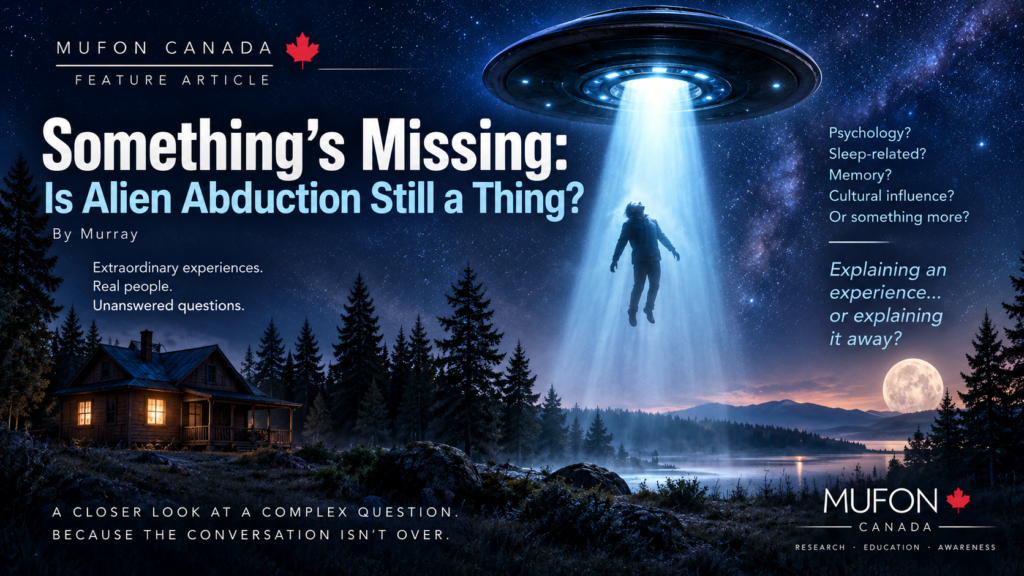
Something’s Missing
Is Alien Abduction Still a Thing?
By Murray Toews
One evening, while attempting to downsize my increasingly out-of-control book collection, I stumbled upon a dusty copy of John G. Fuller’s The Interrupted Journey, which I had read many years before. Flipping through its yellowing pages, I was reminded of the fascination I once held for the improbable story of Betty and Barney Hill—two regular people whose very normal vacation was interrupted by an experience that would eventually become one of the best-known alien abduction stories of the twentieth century.
Driving home through New Hampshire in 1961, the Hills reported seeing a strange object in the night sky. What followed grew into a much stranger account involving missing time, hypnosis and memories of being taken aboard a craft and confronted directly with alleged alien life. It was wonderfully weird stuff.
Revisiting alien abduction, something occurred to me: the old-fashioned, “nuts-and-bolts” abduction story isn’t as much a part of the UFO narrative as it used to be. Through the 1980s and ’90s, abduction seemed to be everywhere – missing time, medical examinations, little grey beings and mysterious craft. Researchers such as Budd Hopkins, David Jacobs and John Mack brought these accounts into books, documentaries and popular culture.
Then the conversation began to change.
Skeptical criticism challenged hypnosis, recovered memories and the influence of popular culture. UFO lore became increasingly tangled with government conspiracy and cover-up narratives. The abductors didn’t exactly disappear; we just stopped talking about them in quite the same way. Experiencer groups still share their stories today, but parts of the conversation have also drifted toward New Age interpretations. Words like interdimensional, consciousness and quantum sometimes get tossed around like Star Trek jargon – scientific-sounding terms freely applied to mysteries they don’t necessarily explain.
So perhaps that was that. Our collective imaginations, cultural influences and a few too many Kraft Dinner suppers (a Canadian delicacy, by the way) had diverted our attention to other matters. I went back to work, navigated Winnipeg construction sites on my way home and binge-rewatched a plethora of late-1990s comedy-dramas.
But today, something was off, and I couldn’t quite put my finger on it. After some thought, I considered that it was strange that it was all so strange, and yet somehow, we just moved on from it. And that got me thinking about strangeness itself.
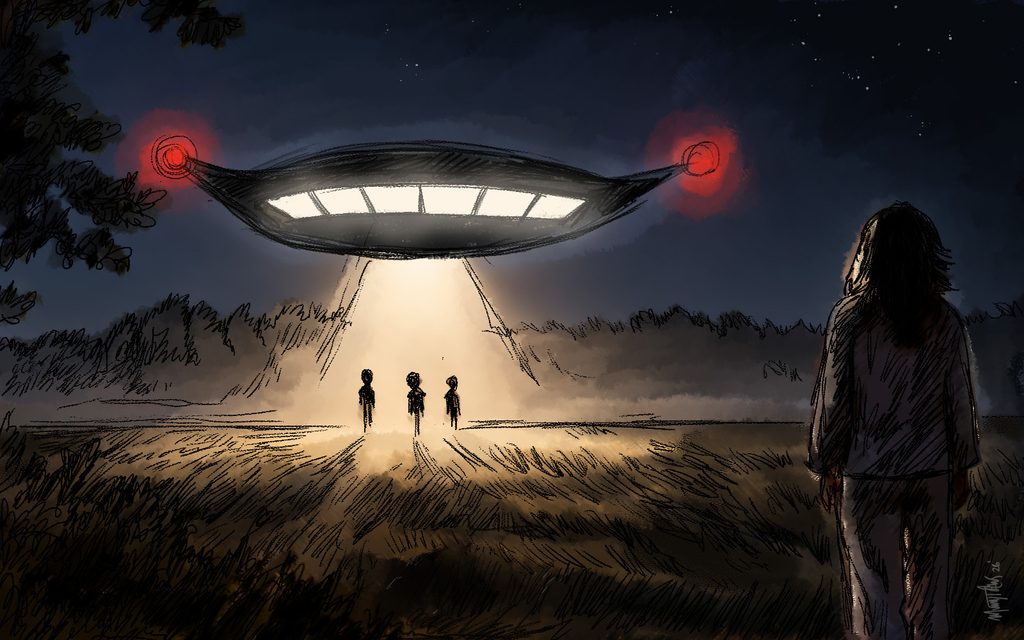
What if we were wrong?
Not necessarily wrong about extraterrestrials. That’s a rather large leap. But what if we were wrong to assume that because we had developed plausible explanations for alien-abduction experiences, we had adequately explained them?
Science has been wrong before. Not because science doesn’t work, but because it does: conclusions change when better observations, instruments and ideas become available. The Earth once appeared perfectly stationary beneath a revolving sky. Disease seemed to follow foul-smelling air. Light, behaving like a wave, seemingly required an invisible medium through which to travel. Each made a certain amount of sense from where we were standing at the time.
That doesn’t mean yesterday’s discarded UFO story becomes tomorrow’s scientific fact. It does mean we should be careful about confusing unlikely with impossible, or an available explanation with a demonstrated one. There is also the considerably messier problem of us.
Human beings are remarkably good at not seeing things that don’t fit comfortably into the world we’ve constructed. We ignore suffering on our streets. Historically, we have doubted people reporting abuse, violence and mistreatment. We sometimes decide which testimony is credible before listening very carefully to what is actually being said. Perhaps we do something similar with extraordinary experiences.
Tell someone you woke unable to move and saw a figure beside your bed, and sleep paralysis offers a compelling avenue of investigation. Tell them you were taken aboard an alien spacecraft and you’ve crossed an invisible social boundary. Suddenly, the experience itself can become secondary to explaining why you believe it happened.
And perhaps that’s perfectly reasonable.
But what if it isn’t always?
That question bothers me. Not because I secretly want the little grey aliens back. I’m not particularly enthusiastic about being hauled out of bed at three in the morning for an unsolicited medical examination – or lured aboard a spacecraft because a plate of mac and cheese has been prepared for me by galactic chefs!
What bothers me is the possibility that somewhere along the way, skepticism can quietly stop being a method of inquiry and become an answer.
We may eventually discover that alien-abduction experiences arise entirely from sleep, memory, psychology, culture and the wonderfully strange machinery of the human brain. But until we better understand these experiences, there remains a small, uncomfortable space between explaining an experience and explaining it away.
And into that little space creeps high strangeness.
There was another problem with simply putting the aliens back on the bookshelf. While we were busy debating the stranger parts of UFO lore, the universe itself was becoming considerably more interesting.
When abduction stories were at their cultural peak, we didn’t yet know whether planets around other stars were commonplace. Today, thousands of exoplanets have been confirmed, including Earth-sized worlds and planets orbiting within regions where conditions might allow liquid water. None of this tells us intelligent life exists on them. We don’t even know how often life gets started.
But the real estate is there.
And if intelligent life arose somewhere else, perhaps it eventually did what we are beginning to do: look outward, discover other potentially habitable worlds and wonder whether anybody lives there. Then comes the difficult part – getting there.
The distances between stars are enormous, and by anything resembling our present technology, travelling between them ranges from extremely difficult to absurdly impractical. But another civilization might have had thousands, millions or even billions of years longer to work on the problem. By hook or by crook—and against odds that may seem virtually impossible to us—perhaps somebody eventually crosses that distance simply to get a better look.
It’s an old-fashioned nuts-and-bolts explanation: beings evolve on a planet, develop technology, build machines and travel somewhere else.
Oddly enough, I find something reassuring about it.
No interdimensional portals. No quantum consciousness. No cosmic vibrations required. Just planets, biology, curiosity, technology and an almost unreasonable determination to cross a very large distance.
It doesn’t explain alien abduction. But it does place one of its strangest underlying propositions—that something intelligent from somewhere else might conceivably find its way here—on somewhat firmer ground than it occupied when I first read The Interrupted Journey.
Strangeness, perhaps, with at least one foot planted in a universe we actually know exists.
I closed the book and put it back on the shelf. Apparently, I wasn’t downsizing my book collection that evening after all.
And after that plate of alien Mac and Cheese, I was still hungry.
Editor’s Note: MUFON investigates reports of anomalous experiences without presuming their cause or origin. Accounts involving alleged abduction, missing time, unusual beings, or other extraordinary experiences may involve a range of possible explanations and should be approached with respect, careful documentation, critical inquiry, and an open mind. The experiences described or discussed in this article should not be interpreted as establishing an extraterrestrial explanation.
About the Author: Murray Toews is a multidisciplinary visual and audio artist, science-fiction writer, UFO researcher and MUFON Field Investigator based in Manitoba. He recently appeared as a UFO researcher on Farpoint Films’ U.F.O P.O.V.