
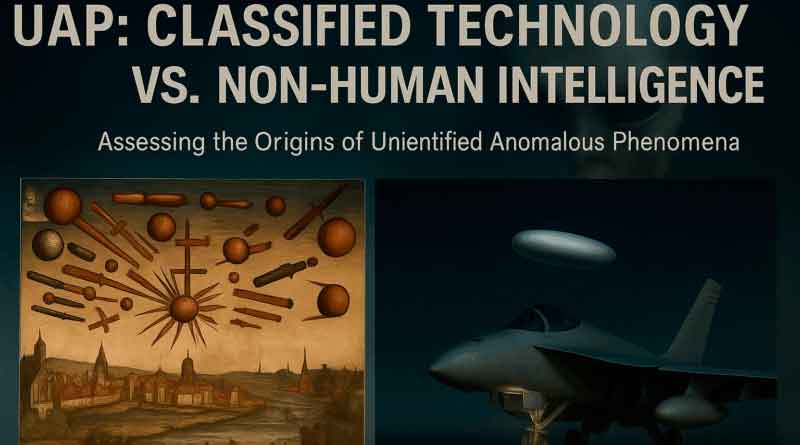
UAP: Classified Technology vs. Non-Human Intelligence – Assessing the Origins of Unidentified Anomalous Phenomena
By Kurtis Blacq | MUFON Canada Assistant National Director, Chief National Case Analyst, Field Investigator, and Director of Finance
What are Unidentified Anomalous Phenomena (UAPs) — cutting-edge classified human technology or evidence of a non-human intelligence? Or maybe both? The answer, whatever it may be, carries profound implications for science and society. In this investigation for MUFON Canada, I explore historic sightings and modern military encounters to weigh the evidence. We’ll see why neither secret aircraft nor simple misidentification can easily explain the best cases, and why many experts are now seriously considering an extraordinary hypothesis. Understanding the true nature of UAPs isn’t just an academic question — it’s critical to our safety and our worldview.
A Mystery That Spans Millennia
Humans have described strange objects in the sky for most of recorded history: radiant orbs, flying disks, glowing rods, and silent triangles. The 1561 mass sighting over Nuremberg, Germany, remains one of the most vivid examples. Citizens witnessed a chaotic aerial “battle” between spheres and cylinders, ending with a large black triangle and the apparent crash of some objects to the ground. Similar events were chronicled in Basel just five years later. These reports, though often interpreted through the lens of religion or superstition at the time, contained descriptions eerily familiar to modern observers.

“Celestial phenomenon over Nuremberg,” woodcut by Hans Glaser, printed in Nuremberg, Germany, April 14, 1561
The 1896–1897 wave of “mystery airship” sightings across North America — decades before powered flight — saw hundreds of reports of structured craft with bright lights, occasionally described as being piloted. These accounts were published in newspapers and often involved multiple witnesses.
Critically, many of these historical reports share common characteristics with today’s UAP encounters: metallic appearance, shape consistency (discs, cylinders, spheres), erratic or intelligent movement, and an apparent disregard for the technological limits of the time. One may look to Wonders in the Sky by Jacques Vallée and Chris Aubeck for an entire catalog of similar historic sightings. If all these reports are dismissed as misperceptions or fabrications, one must contend with a consistent pattern of global delusion across cultures and centuries — which is, in itself, unlikely.
Modern Military Encounters: More Sensors, Same Story
Fast-forward to the modern era, and reports continue — but with one major difference: they’re now backed by advanced technology and trained military observers.
The 2004 USS Nimitz encounter remains the gold standard. Navy pilots and radar operators observed a Tic Tac-shaped object exhibiting flight capabilities that defy known physics: instantaneous acceleration, hovering with no visible propulsion, and travel from 80,000 feet to sea level in less than a second. Cmdr. David Fravor’s firsthand account, supported by radar and infrared (FLIR) tracking, describes an object that responded to pilot movements and then reappeared 60 miles away in under a minute.
Similar encounters occurred in 2014–2015 with Navy pilots off the East Coast. Lt. Ryan Graves reported near-daily interactions with UAPs during training flights — objects with no wings or engines, hovering in high winds and accelerating to supersonic speeds. These were also picked up by multiple sensor systems.
The Pentagon has now confirmed that at least 80 UAP cases involved multiple sensor types (radar, FLIR, visual, and others). A small subset — around two dozen — remains unexplainable even after thorough analysis, showing flight characteristics well beyond anything in known military arsenals.
Why Classified Tech Doesn’t Fully Explain It
Some argue that these sightings could be experimental aircraft, black projects, or foreign drones. There’s historical precedent: the U-2 spy plane and early stealth bombers were once misidentified as UFOs by both civilians and the military.
However, this explanation breaks down when applied to the best-documented modern cases. Consider the following:
• Extreme performance: Hypersonic speeds without sonic booms, zero inertia effects, and trans-medium travel (air to water) are not attributes of any known aircraft — even experimental ones.
• No observable development: If these technologies existed in 2004 (USS Nimitz) or earlier, we would likely have seen signs of deployment or technological trickle-down. None have emerged.
• Official denials: U.S. officials with clearance over special access programs — including former DOD insiders — have stated they have seen no evidence that these UAP are American projects. Likewise, Pentagon assessments say there’s no indication that foreign adversaries possess this level of capability.
• Global consistency: These objects are being reported by militaries and civilians alike around the world. If this were a state-level black project, its exposure over nuclear bases, warships, and restricted airspace — sometimes for hours at a time — would be both illogical and reckless.
The “classified tech” hypothesis simply doesn’t account for the breadth, consistency, and longevity of the phenomenon.
Non-Human Intelligence or an Unacknowledged SAP?
After eliminating mundane explanations, foreign adversaries, and acknowledged military projects, two leading theories emerge to explain the UAP phenomenon. Either these objects are manifestations of a Non-Human Intelligence (NHI) — such as extraterrestrial or otherwise non-human entities — or they stem from deeply Unacknowledged Special Access Programs (USAPs), meaning secretive human-developed technology operating outside normal oversight. Both hypotheses are considered rational responses to the data, given that some UAP cases exhibit capabilities far beyond any publicly known technology. Below we outline each possibility and why neither can be ruled out in light of current evidence.
Non-Human Intelligence (NHI) Hypothesis
The NHI hypothesis posits that some UAP may be vehicles or technologies of non-human origin, potentially designed or controlled by an advanced intelligence not from our civilization. Because no black-budget U.S. aircraft or drone known today can duplicate these extremes of speed and agility, it is argued that an exotic origin may be the only plausible explanation.
The NHI theory encompasses a range of possibilities — most often extraterrestrial visitors, but also conceivably advanced AI or interdimensional phenomena — essentially, any intelligence not arising from human society. While extraordinary, this hypothesis is bolstered by the recognition that a few UAP cases remain genuinely unexplained even after rigorous analysis.
Official government reports have noted that the vast majority of sightings turn out to be misidentifications or prosaic objects, yet a “tiny percentage” resist explanation. Significantly, the U.S. Department of Defense has stated it has no evidence so far of alien technology behind UAP, but it has not ruled out the possibility — especially given the limitations of current physics to account for what some sensors and observers have recorded. Even NASA’s 2023 UAP panel acknowledged these anomalous cases, stressing the need for further scientific scrutiny rather than outright dismissal.
Proponents of the NHI hypothesis also point to recent insider testimony that suggests an NHI presence. In 2023, a former intelligence officer turned whistleblower, David Grusch, publicly claimed that a clandestine U.S. program has retrieved “non-human” craft and even biologics from crash sites. He testified under oath that information about these retrieved technologies has been illegally shielded from Congress for decades. While Grusch’s assertions remain unverified — and extraordinary claims require extraordinary evidence — his willingness to provide hours of classified testimony to government investigators indicates that the NHI hypothesis is taken seriously by some credible insiders.

Former U.S. intelligence officer David Grusch testifies before the U.S. House Oversight Committee on Unidentified Anomalous Phenomena (UAP) in Washington, D.C., on July 26, 2023.
In short, the idea of non-human intelligence behind UAP remains plausible because it would neatly explain the seemingly physics-defying feats observed in the best cases. If an advanced extraterrestrial or otherwise non-human civilization has achieved a level of technology centuries (or millennia) beyond our own, their craft might well appear miraculous to us — just as our modern aircraft would to people a few hundred years ago. Until we either obtain hard evidence of such an intelligence or, alternatively, uncover a terrestrial technology that can mimic these capabilities, the NHI hypothesis stands as a rational, albeit extraordinary, interpretation of the data.
Unacknowledged Special Access Program (USAP) Hypothesis
The other leading explanation is that UAP could be highly classified human technology — the product of Unacknowledged Special Access Programs. A Special Access Program (SAP) is a highly classified project with restricted access, and an unacknowledged SAP is one whose very existence is kept secret (often even from many high-ranking officials).
In such programs, information and funding are tightly compartmentalized; in fact, by law, the Pentagon can waive normal reporting requirements to Congress for a SAP in rare cases. This means a “waived” USAP can operate with minimal external oversight, its budget buried in other line items, and it will not appear in response to Freedom of Information Act requests. In theory, a sufficiently black program — perhaps run in partnership with defense contractors like Lockheed Martin or Northrop Grumman — could develop breakthrough aerospace technology away from public view, even to the point of appearing extraterrestrial.
History proves that secret military projects can stay hidden for years. The Manhattan Project (which developed the atomic bomb) and cutting-edge aircraft like the stealth F-117 Nighthawk were concealed until unveiled in more public settings. It’s well documented that the U.S. spends on the order of tens of billions of dollars annually on classified R&D.
The USAP hypothesis suggests that some of those hidden efforts may have yielded dramatic leaps in physics and engineering — for example, mastering gravity manipulation, inertia cancellation, or novel energy sources — which, if achieved, would produce craft with flight characteristics indistinguishable from “science fiction.” One variant of this idea, discussed by researchers such as Richard Dolan, is the emergence of a “breakaway civilization.” In Dolan’s scenario, a small group of government and industry elites discovered revolutionary physics, or even new understandings of consciousness, that enabled technologies far ahead of our time, and they seceded into secrecy.
This hypothetical breakaway group would possess capabilities like advanced propulsion and materials, all while operating in the shadows. They would form a sort of secret parallel civilization — reaping the benefits of these extraordinary technologies (possibly derived from UAP crash recoveries and/or radical research) and intentionally keeping them hidden from the public and even most of the military. While speculative, the breakaway civilization concept underlines that if humans are behind the most extreme UAP, then a profound compartmentalization of knowledge must have occurred, allowing a select few to leap far beyond conventional science.
Crucially, the USAP hypothesis helps explain the oversight gap that often comes up in UAP discussions. If UAP are secret human projects, why haven’t our elected officials or mainstream scientists been informed? The answer: these programs would be structured explicitly to bypass standard oversight. They could be hidden in private aerospace facilities (which are harder to scrutinize than government labs) and protected by onerous security oaths.
Indeed, there is evidence that some UAP-related programs have been deliberately shielded from inquiry. Former Senate Majority Leader Harry Reid, who sponsored the Pentagon’s 2007–2012 UAP research program (AATIP), has stated that he was told a major defense contractor had recovered exotic materials believed to be related to UFOs — and when he tried to get Pentagon clearance to view them, he was denied. “They would not approve it,” Reid said of his attempt to access the alleged legacy program, noting he “was told for decades that Lockheed had some of these retrieved materials.”
If even a powerful senator could not penetrate a suspected UAP technology project, it illustrates how deeply buried a USAP might be. In line with this, officials like Christopher Mellon (former Deputy Assistant Secretary of Defense for Intelligence) have pointed out that special access programs are often hosted at aerospace companies and can evade the normal chain of command. Funding can be routed via shell companies and “waived” unacknowledged projects that report only to a tiny cadre of insiders.
In short, traditional oversight mechanisms (Congress, GAO audits, FOIA, etc.) may simply not be calibrated to detect a sufficiently well-protected black program. This makes the USAP explanation plausible: it’s conceivable that an aerospace Manhattan Project has been running in the background for decades, producing craft that, to the uninitiated, look like extraterrestrial vehicles.
However, if UAP are secret human technology, it means known “black” tech is still insufficient to explain them — we would need unknown black tech. The most advanced aircraft publicly known (think of hypersonic missiles or stealth drones) still operate within the confines of standard physics: they produce heat and sonic booms, they cannot execute instantaneous 90° turns, and they certainly can’t hover silently one moment and then zip to space the next. Yet those are exactly the sorts of extreme behaviors documented in the best UAP cases.
The USAP hypothesis requires believing that somewhere within the aerospace world, a revolutionary breakthrough was made — perhaps tapping into physics that mainstream science has yet to grasp. Is this impossible? Not necessarily. For instance, if scientists in a covert project figured out how to mitigate inertia or generate directed gravity fields, the resulting craft would seem to defy our current aeronautical knowledge. From the outside, that would be indistinguishable from magic. While no such breakthrough is acknowledged publicly, the absence of public proof doesn’t preclude its existence in private.
Given the high stakes of technologies that could confer global strategic advantage, it’s not hard to imagine why those involved would keep it under wraps. Thus, the USAP hypothesis remains on the table because history and the structure of military secrecy show that “unknown unknowns” can exist. Until we have full transparency, we can’t discount the possibility that we have built some of these “impossible” craft under highly controlled secrecy.
Why These Two Theories Remain Viable
Ultimately, each of these hypotheses — NHI and USAP — remains viable because each addresses aspects of the UAP mystery that the other known explanations cannot. Non-Human Intelligence offers a compelling answer for UAP with beyond-next-generation capabilities that no known human program can achieve, highlighting the limits of our current knowledge of physics, and explaining the consistency of these observed phenomena throughout history.
Meanwhile, the Unacknowledged SAP scenario accounts for the extensive gaps in public oversight and secrecy that seem to surround the UAP topic, showing how even earth-shaking technologies could be hidden in plain sight.
Notably, these two ideas are not mutually exclusive; it’s conceivable that both play a role. For example, a secret program could exist because an NHI presence was discovered. Regardless, the reason these theories dominate the discussion is that no conventional explanation fits the extreme cases.
As MUFON researchers and other scientifically literate investigators point out, the most extreme UAP incidents push us right up against the frontier of the known — either pointing to someone else’s advanced technology or to astonishing advances of our own kept secret. Without more data and transparency, we cannot say definitively which is true.
But given the extraordinary nature of the phenomena, non-human intelligence and unacknowledged human programs remain the two leading rational hypotheses supported by the evidence at hand. Each hypothesis, if true, carries profound implications — either confirming that we are not alone, or revealing that human institutions have achieved, and concealed for decades, near-miraculous feats of engineering.
For now, serious UAP inquiry keeps both possibilities in mind, recognizing that we may be confronted with either an intelligence beyond our known civilization or a level of human innovation that has outpaced our public institutions — or, just possibly, some combination of both. In the face of the unknown, open-minded, evidence-based consideration of both scenarios is not only reasonable but necessary.
If evidence of possible non-human craft or USAPs has been mounting, one might ask: why isn’t this front-page news worldwide? The reality is that despite the compelling encounters, whistleblower testimonies under oath, and official reports, UAP disclosure hasn’t yet dominated public attention.
In the next article, we’ll explore the fascinating reasons behind this paradox. From cultural stigma and the “giggle factor” to psychological resistance and possible institutional secrecy, we’ll delve into why the world is still so slow to fully wake up to the UAP mystery — and whether that might be starting to change.