
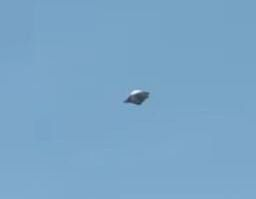
Alleged UFO Recorded in Campinas (SP) Sparks Debate Among Researchers
By C. Andrade CIFE
Initial Case Data
• Date: December 25, 2025
• Time: 09:52 a.m.
• Location: Anhanguera Highway, Campinas region, São Paulo, Brazil
• Record type: Video
• Device: iPhone 16
• Witness: User identified as @michelli.azuma (Instagram)
• Approximate vehicle speed: ~100 km/h
Event Description
In recent days, a video showing an unidentified aerial object has circulated widely on social media, generating debate among researchers, enthusiasts, and investigators in the field of ufology. The footage was reportedly recorded on December 25, 2025, at approximately 09:52 a.m., while the witness’s vehicle was traveling along the Anhanguera Highway near Campinas, São Paulo.
The object appears to move across the sky at an apparently high speed, drawing attention due to the contrast between its motion and that of the vehicle, estimated at around 100 km/h. This perception has led some observers to suggest the possibility of a craft of non-conventional origin.
Other researchers, however, point to more conventional explanations, suggesting that the object may correspond to a hot air balloon, a phenomenon frequently misidentified as a UFO due to its variable altitude, reflected light, and seemingly erratic behavior when observed from a distance.
Video Source: https://www.instagram.com/reel/DSyKxvuEq_D/?igsh=M3ZvdGtxeDYyazVk
Preliminary Technical Analysis
The impression of high speed observed in the video may be associated with the so-called parallax effect, a well-documented optical phenomenon. This effect occurs when the observer is in motion, causing distant objects to appear to move faster relative to the background, without representing their true physical velocity.
In the context of the analyzed recording, the combination of:
• vehicle movement,
• camera angle,
• indeterminate distance to the object,
• lack of fixed reference points in the sky,
• digital video compression,
may significantly contribute to misinterpretations regarding the kinematic behavior of the observed phenomenon.
At this time, the following materials have not been made available:
• complete metadata from the original file,
• detailed meteorological data for the time of recording,
• wind speed and altitude information,
• frame-by-frame photogrammetric analysis,
which limits the possibility of definitive conclusions.
Preliminary Case Classification
According to the J. Allen Hynek system
The case may be provisionally classified as:
• DD – Daylight Disc, if the object presents a defined shape observable in daylight; or
• NL – Nocturnal Light / Daylight Light, depending on final analysis of morphology and luminosity.
This classification remains provisional, pending additional technical data.
Classification According to Jacques Vallée
Based on the typology proposed by Jacques Vallée, the case may initially be classified as:
Category I – Distant Aerial Anomalies
This category includes:
• aerial objects observed at a distance,
• isolated visual records,
• absence of physical, electromagnetic, or physiological effects,
• limited data preventing definitive determination of the phenomenon’s nature.
Within this framework, the event fits the profile of a distant aerial observation without interaction, typical of preliminary cases requiring further verification before more advanced conclusions can be drawn.
Preliminary Conclusion
Based on the information currently available, the case remains inconclusive. While a conventional explanation such as a hot air balloon cannot be ruled out, there is also insufficient technical evidence to confirm this hypothesis with certainty.
Likewise, there is no objective data allowing the assertion that the object represents a craft of extraterrestrial origin.
The case remains open to further analysis and depends on:
• access to the original video file,
• metadata examination,
• photogrammetric analysis,
• local meteorological data,
• additional independent witness reports.
Only after these verification steps will it be possible to advance toward a more definitive classification under the scientific protocols used in contemporary ufological research.
Editorial Note
The apparent high speed observed in the video may be related to the parallax effect, an optical phenomenon in which observer motion creates the illusion of accelerated movement in distant objects, without reflecting their actual velocity.
Thus, the case remains inconclusive and may involve anything from a conventional phenomenon such as a hot air balloon to an object not yet identified, depending on further technical analyses.
Source: C. Andrade – Editor, CIFE (Scientific Channel of UFO’s Phenomena & Space Research)
www.cife.ca
In cooperation with daily materials published by Revista UFO – www.ufo.com.br
When sharing this article, please credit:
C. Andrade – www.cife.ca, based on a record originally published by @michelli.azuma (Instagram).